
Use Cases

Where the architecture becomes necessary

Autonomous systems create machine-scale authority and consequence across every major operational domain. These are the environments where existing observation and detection models are structurally insufficient.

Architecture
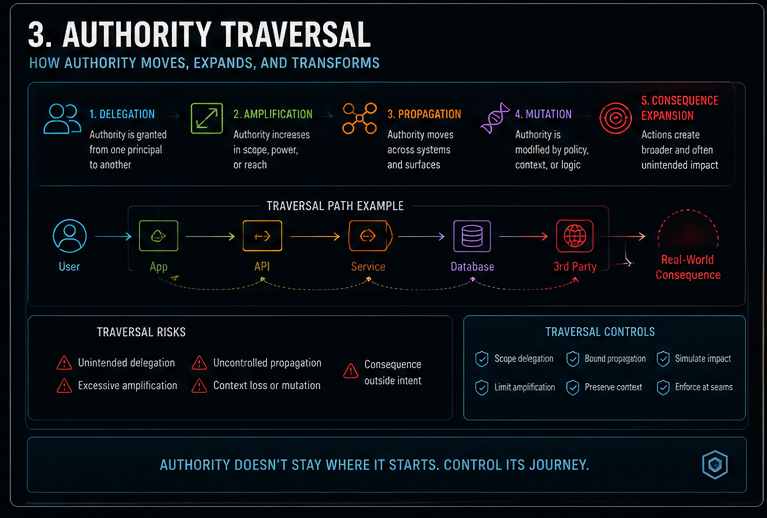
Diagram showing authority moving through systems, APIs, agents, and external services while amplifying or mutating before consequence.
Authority traverses systems faster than organizations can interpret it.
AI Financial Operations01

Machine-speed transactions without consequence boundaries

The Problem

AI agents and automated workflows are being authorized to initiate, approve, and route financial transactions. The authorization structures assume human review cycles that no longer exist.

Failure Mode

A delegated AI agent accumulates approval authority across multiple payment systems. A single compromised prompt or policy drift enables large-scale unauthorized transfers before any human observer can intervene.

Why Current Systems Struggle

Fraud detection and monitoring systems observe transactions after execution. They are not positioned at consequence boundaries. By the time an anomaly is flagged, consequence is already realized.

Architectural Response

Receiver-edge enforcement at financial consequence seams. Authority constraints applied before transaction execution, not after. Dynamic risk weighting adjusts enforcement thresholds based on live system state and delegation context.

Consequence Boundary

Financial consequence

AI Agent Action Control02

Autonomous agents with expanding authority surfaces

The Problem

AI agents deployed inside enterprise environments hold legitimate credentials and execute real actions across systems. Their authority surfaces expand through integration, delegation, and orchestration in ways that are not structurally tracked.

Failure Mode

An agent authorized for task coordination gradually acquires write access across connected systems through API integrations. Authority drifts beyond designed scope without triggering access control alerts because each individual permission appears legitimate.

Why Current Systems Struggle

Identity and access management systems track credentials, not consequence surfaces. They cannot model what an agent can cause in combination — only what it is technically permitted to access.

Architectural Response

Authority surface mapping across agent integration chains. Consequence seam identification at each action boundary. Structural constraints that enforce bounded autonomy — preventing consequence accumulation beyond designed authority scope.

Consequence Boundary

Identity, policy, and operational authority

Identity Authority Drift03

Authority accumulation across identity lifecycle

The Problem

Enterprise identity systems accumulate permissions across organizational transitions, system integrations, and role changes. Effective authority diverges from designed authority without triggering review thresholds.

Failure Mode

A service account provisioned for a legacy integration retains access to production systems after the integration is deprecated. The account's authority surface is never recalculated. It becomes a dormant amplification vector.

Why Current Systems Struggle

Access reviews assess permissions against current policy, not consequence surfaces. A technically authorized account can hold structurally dangerous authority that is never visible in compliance reporting.

Architectural Response

Authority drift detection through continuous surface recalculation. Identification of consequence accumulation across identity lifecycle events. Structural model of actual authority versus designed authority — not policy versus credential state.

Consequence Boundary

Identity and authorization authority

Autonomous Procurement04

Delegated systems binding organizations contractually

The Problem

Procurement workflows delegate approval authority to automated systems for vendor selection, contract initiation, and purchase execution. The authority to bind the organization is exercised at machine speed.

Failure Mode

An automated procurement agent operating within budget parameters executes a series of vendor agreements that individually comply with approval limits but collectively represent a commitment the organization did not intend to authorize.

Why Current Systems Struggle

Procurement controls are designed around transaction-level approvals. They do not model cumulative consequence across an autonomous workflow. Aggregated consequence exceeds organizational intent without any individual transaction triggering review.

Architectural Response

Consequence aggregation modeling across procurement authority chains. Enforcement architecture that applies organizational intent constraints at the workflow level, not only at individual transaction boundaries.

Consequence Boundary

Contract and financial consequence

Enterprise Workflow Delegation05

Authority propagating across orchestration layers

The Problem

Modern workflow orchestration delegates authority across services, APIs, and automated agents. Authority traverses organizational boundaries, service meshes, and policy domains before consequence is realized.

Failure Mode

A workflow authorized at the initiating system passes authority through multiple orchestration layers, each applying local policy. By the time execution reaches consequence-bearing systems, the original authority context has been transformed, abbreviated, or lost entirely.

Why Current Systems Struggle

Observability systems collect telemetry across workflow execution but reconstruct continuity retrospectively. When authority context mutates during traversal, centralized reconstruction cannot determine whether realized consequence remained bounded to original intent.

Architectural Response

Structural continuity carriage preserving authority context across orchestration boundaries. Consequence seam enforcement at receiver edges. Provenance preservation maintaining replay-equivalent lineage across workflow mutation.

Consequence Boundary

Policy, operational, and organizational authority

Critical Infrastructure Automation06

Physical consequence systems governed by software authority

The Problem

Industrial control systems, building infrastructure, and operational technology environments are increasingly managed through software authority structures. The consequences of authority failure are physical, irreversible, and potentially catastrophic.

Failure Mode

A compromised software component operating with legitimate credentials issues control commands that fall within individual parameter limits but produce cumulative physical consequences outside designed operational boundaries.

Why Current Systems Struggle

OT security tools monitor network traffic and endpoint state. They are not positioned to evaluate consequence surfaces or enforce authority boundaries at the point where software authority produces physical effect.

Architectural Response

Authority architecture analysis of control system integration points. Consequence seam identification at software-to-physical boundaries. Enforcement architecture that constrains irreversible physical consequence to organizationally bounded authority.

Consequence Boundary

Physical consequence

Defense and Mission Systems07

Autonomous systems with mission-critical authority

The Problem

Defense and mission environments increasingly delegate authority to autonomous systems that must operate under dynamic, adversarial, and time-constrained conditions. Authority boundaries must survive operational complexity without centralized runtime coordination.

Failure Mode

An autonomous system operating within designed mission parameters makes a sequence of locally valid decisions that collectively produce a consequence outside mission authority — in conditions where centralized oversight is unavailable or has been disrupted.

Why Current Systems Struggle

Mission system controls are primarily designed around command authority and rules of engagement. They do not provide structural models of consequence surfaces or enforce bounded autonomy at the architectural level under degraded coordination conditions.

Architectural Response

Separated plane architecture for consequence enforcement, continuity carriage, and provenance preservation. Local consequence sovereignty that constrains irreversible realization without centralized runtime authority. Authority integrity preserved under distributed mutation.

Consequence Boundary

Operational, physical, and mission authority

Reference
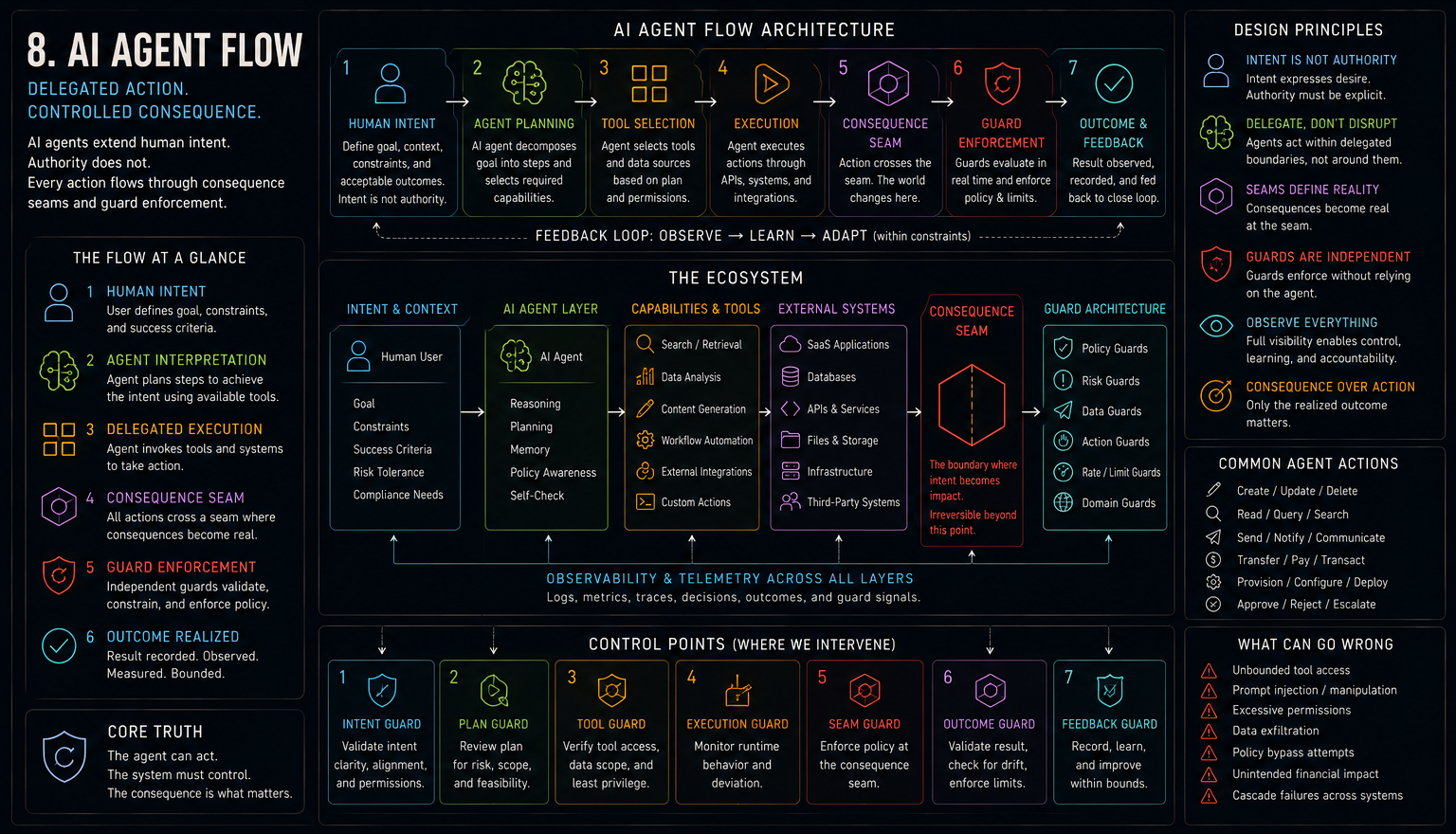
Diagram showing human intent moving through AI agent planning, tool use, external systems, consequence seam, and guard enforcement.
Delegated action requires consequence-bound enforcement.
Reference
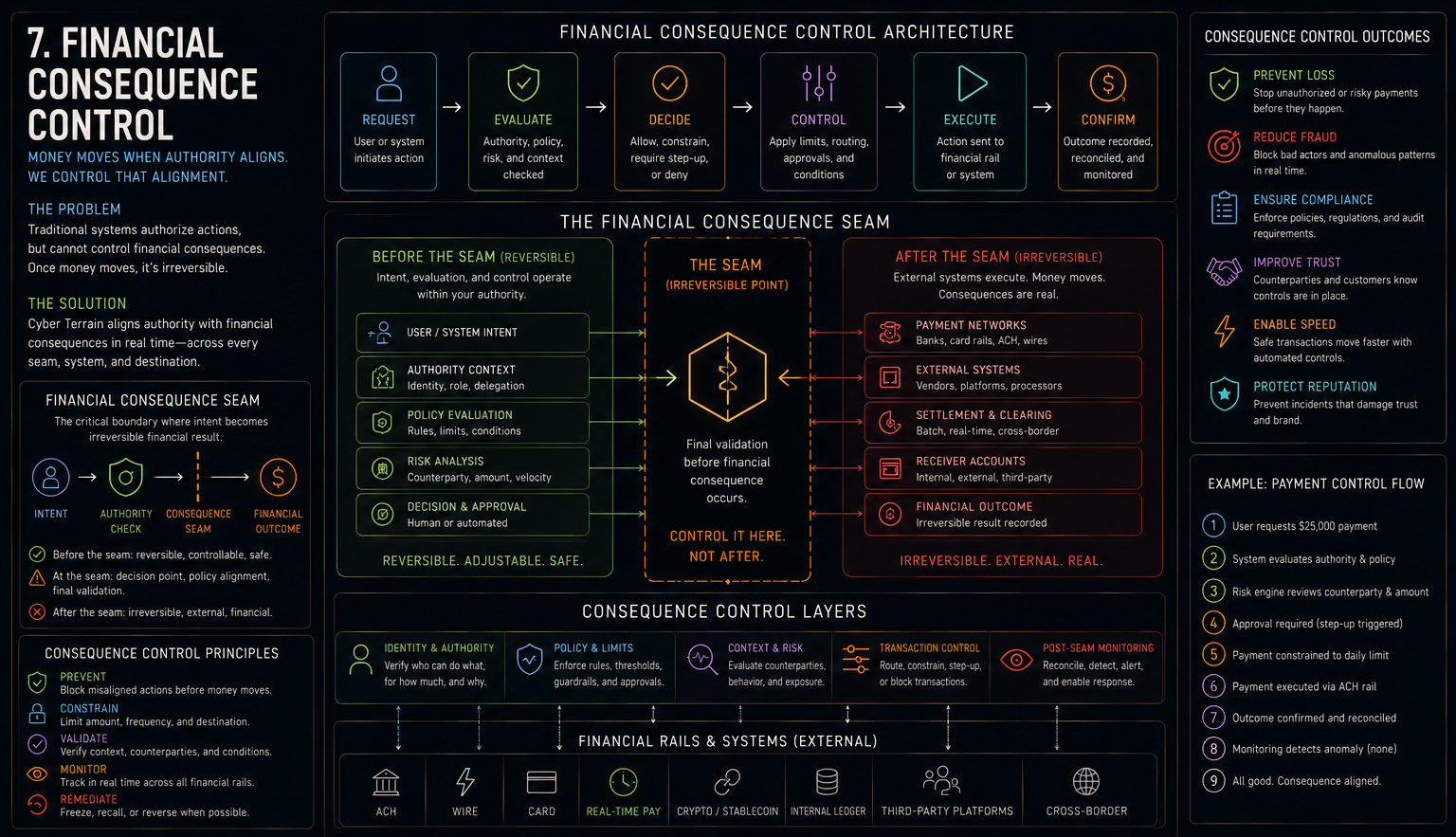
Diagram showing financial authority moving through validation, consequence seam, and payment release before irreversible financial outcome.
The financial seam is where authorization becomes value movement.

Consequence control starts with architecture.

These environments share a common failure: existing systems observe or detect after consequence is realized. Authority Engineering provides the structural model for enforcing bounded autonomy before execution reaches consequence boundaries.